
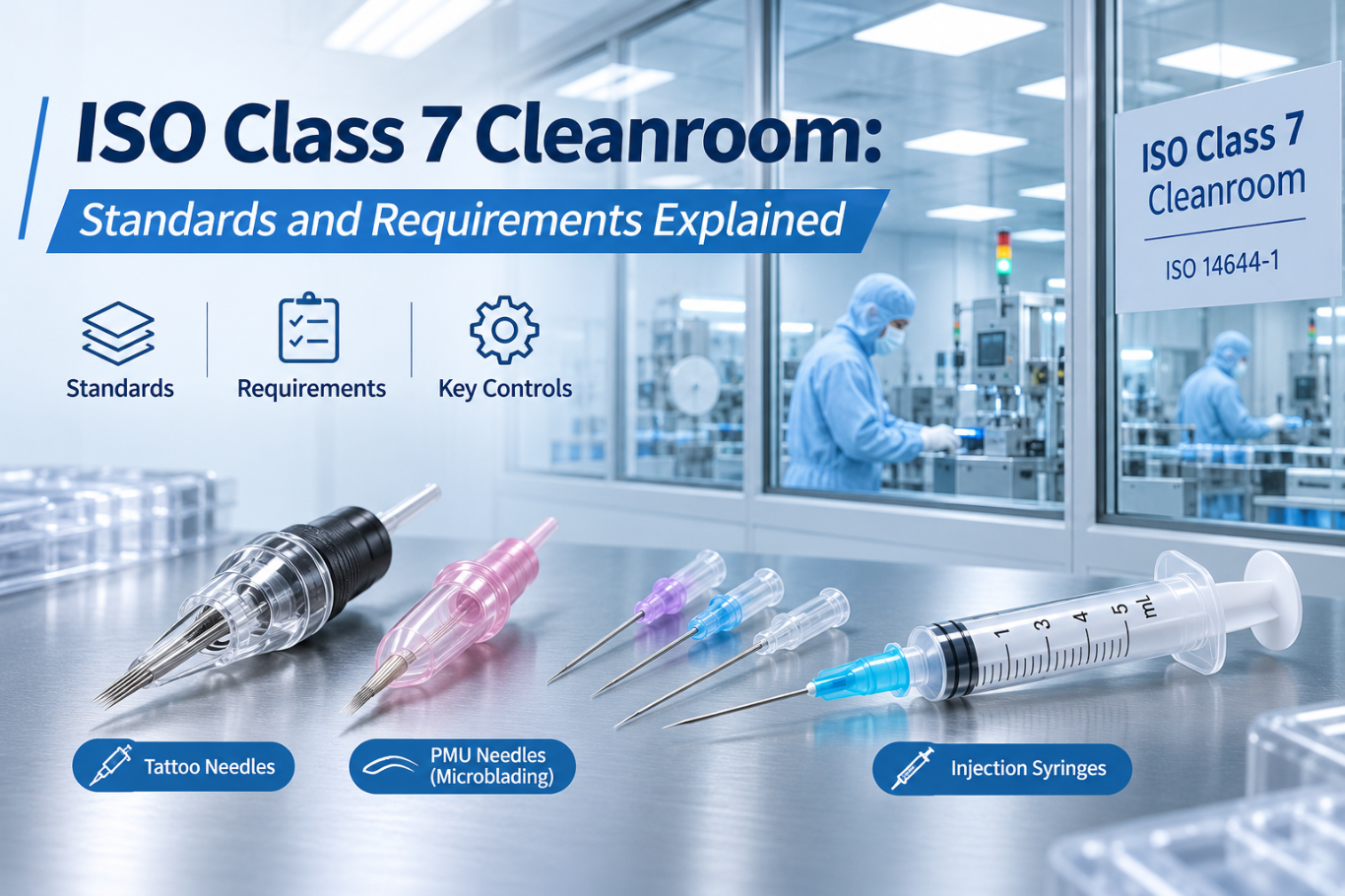
R&G Bio is a brand manufacturer of tattoo needles, cosmetic needles, syringes and other beauty and medical products. Our products have very high production standard. The assembly, inspection and packing are all finished in ISO class 7 cleanroom. Many customers maybe only have a vague idea about ISO 7 cleanroom. This article will introduce the definition and requirements of ISO 7 cleanroom in detail. It will tell you what it means in the production process, what effect it has on the final product quality, and what efforts we do in daily running to produce good quality products that you can use with no worry.
What Exactly Is an ISO Class 7 Cleanroom?
First let us introduce what is a cleanroom. Cleanroom is also called dust free room or clean workshop. Just like its name, a cleanroom is a special controlled environment that have high requirement on the cleanliness. In this environment, the particles, harmful air, bacteria and other contaminants in the air are strictly controlled. They are removed or kept at a limited level. Then, by using purification air conditioning, filtration system and other technology, the temperature, pressure, air speed, noise, lighting and static electricity in the room are adjusted to the required range, so the room environment can reach the related standard. No matter how the outside environment changes, the condition inside the cleanroom always keep the original set level. In this way, the medical devices, medicines, biochemical products and precision electronic products produced in the cleanroom can keep high quality, safety and batch consistency.
“ISO Class 7” is a classification of cleanroom air cleanliness based on the international standard ISO 14644-1. The classification is based on the amount of floating particles in each cubic meter of air. ISO 7 requires: each cubic meter cannot have more than 352,000 particles of 0.5 micron.
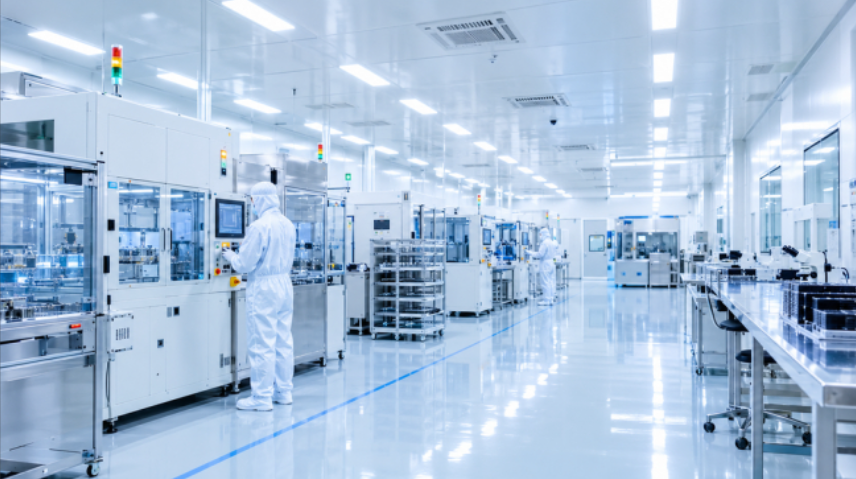
How ISO 14644-1 Defines Cleanroom Classes
The cleanliness level is divided from ISO 1 to ISO 9. The smaller the number, the higher the cleanliness. The most commonly used level is ISO 7. Besides, ISO 5, ISO 6 and ISO 8 are also common. The standard of each level not only look at the amount of floating particles in each cubic meter, but also look at the particle size.
From FED-STD-209E Class 10,000 to ISO 7: What Changed
Many old customers and engineers are used to say “wan ji cleanroom” (Class 10,000), but the new buyers who just contact these products maybe not understand. This saying actually comes from the old American standard FED-STD-209E. It is named by the number of particles in each cubic foot. Class 10,000 means the particles bigger than or equal to 0.5 micron in each cubic foot of air do not exceed ten thousand. This standard was abolished in 2001, and the new standard is ISO 14644-1.
But the old sayings like “wan ji” and “shi wan ji” are still often used in the industry. Many customers also mention these old names when they talk with us about ISO 14644-1. How to call this standard is not a big problem, but the acceptance and certification should be confirmed according to the new standard ISO 14644-1 (ISO 14644-1 corresponds to the old standard Class 10,000).
Where ISO 7 Sits on the Cleanliness Scale (ISO 5 to ISO 9)
|
ISO Class |
≥0.5 µm Particle Limit (particles/m³) |
≥5 µm Particle Limit (particles/m³) |
FED-STD-209E Equivalent |
Typical Air Changes per Hour |
|---|---|---|---|---|
|
ISO 5 |
3,520 |
29 |
Class 100 |
300–500 |
|
ISO 6 |
35,200 |
293 |
Class 1,000 |
150–240 |
|
ISO 7 |
352,000 |
2,930 |
Class 10,000 |
60–90 |
|
ISO 8 |
3,520,000 |
29,300 |
Class 100,000 |
15–25 |
ISO 5 (Class 100) is used for sterile filling, implantable devices and other processes with the highest requirements. The cost and energy consumption of ISO 5 are very high. ISO 6 (Class 1,000) is mostly used for precision optics and high end electronic packaging. ISO 7 (Class 10,000) is the most common level for medical device assembly and pharmaceutical liquid preparation. ISO 8 (Class 100,000) is often used in injection molding, food and ordinary cosmetics production.
From the table above you can see, ISO 7 is at a medium high level. Because this ranking cannot only look at the class number, you also need to look at the particle limit. The particle limit of each level is ten times of the previous level. If compare with normal indoor environment like office, the particle limit of ISO 7 is only a few hundredths of the normal environment. And ISO 7 does not need very high construction cost and running cost like ISO 5. From the angle of giving customers the best balance of price and quality, ISO 7 is more commonly used in the industry.
ISO 7 Particle Count Limits: The Numbers That Matter
The table below shows the core particle limits of ISO 7:
|
Particle Size |
Maximum Allowable Particles per m³ |
Description |
|---|---|---|
|
≥ 0.5 µm |
352,000 |
Core assessment indicator |
|
≥ 1.0 µm |
83,200 |
Auxiliary assessment particle size |
|
≥ 5.0 µm |
2,930 |
Strict limit for larger particles |
In ISO 7 cleanroom, the bigger the particle size, the more strict the limit number. Because particles that too big will attach on the product surface, and more easy to affect and contaminate products like syringes and needles.
At-Rest vs. In-Operation: Why the Testing State Matters
Many customers are wonder about how the cleanroom is tested. The cleanliness is usually tested in three states:
The data tested in these three states are very different. Especially the in-operation state is the most hard to reach the standard, because equipment running, workers walking, and materials going in and out will all bring particle contamination. So we also put a lot of efforts to keep the cleanroom in a compliant state.
For customers, good looking at-rest data cannot prove anything. What really shows the daily production level is the in-operation data. So when the buyer do factory audit, the most worth to see is also the in-operation monitoring records.
How Particle Counts Are Measured and Verified
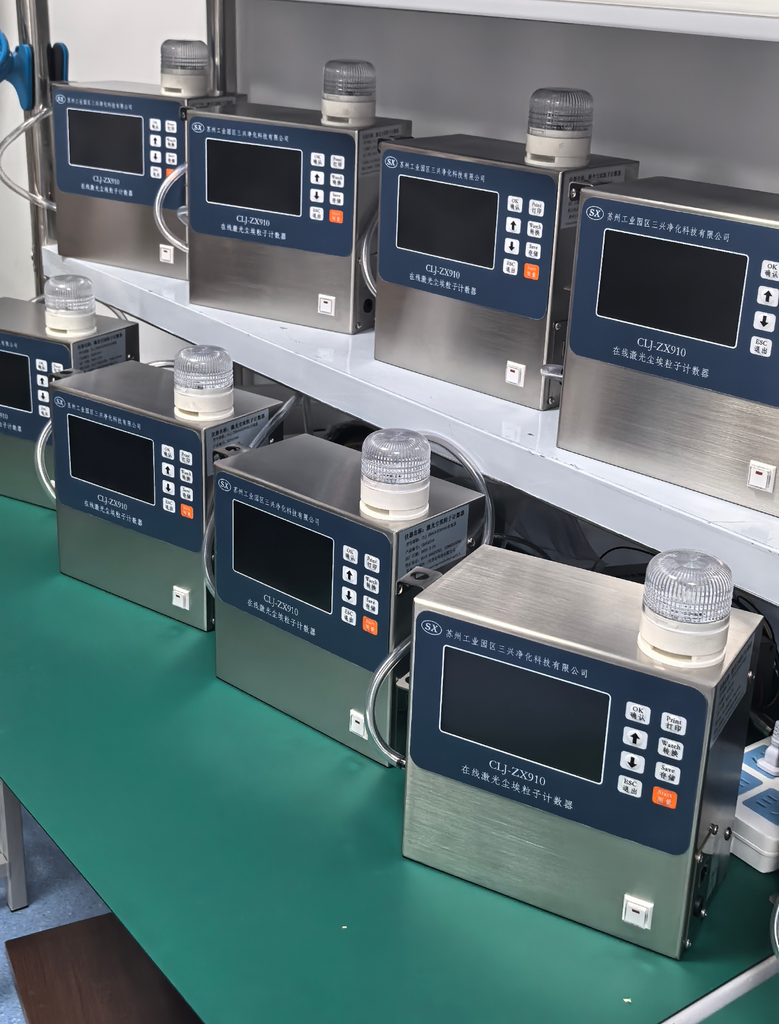
Particle counting is usually done with a special instrument, that is the laser particle counter. According to the points and sampling volume required by the standard, measuring point by point, then you can get the test result of particle content in the air. The formal ISO 7 certification is not tested by the factory itself, but is done by a third party testing agency and they issue the report. We will also provide this report to customers when audit.
Engineering an ISO 7 Environment: Airflow, Filtration, and Pressure Control
So when we run the cleanroom, how do we make the particle limits reach the standard? The answer is to rely on the air conditioning purification system.
Air Changes per Hour: The 30–60 (to 90) ACH Design Range
In the industry, the air changes of ISO 7 cleanroom is usually set at 30 to 60 times per hour. For workshops with higher process requirements and more workers, it will be set to 60 to 90 times. Maybe you are not very clear about this concept of air changes, so here is an example: the air changes of a normal office is only about 2 to 4 times per hour. The air changes of a cleanroom is more than ten times of normal living environment. The more frequent the air changes, the faster the floating particles in the air are taken away, and the cleanliness is more stable.
HEPA Filtration and Non-Unidirectional Airflow
The airflow of cleanroom is divided into unidirectional flow and non-unidirectional flow. Unidirectional flow means the air blows out evenly from one whole ceiling or wall, and flows in parallel straight lines to the other side. Non-unidirectional flow means setting several air supply outlets spread on the ceiling. After the air comes in, it mixes with the indoor air, and dilutes the concentration of floating particles to within the qualified line.
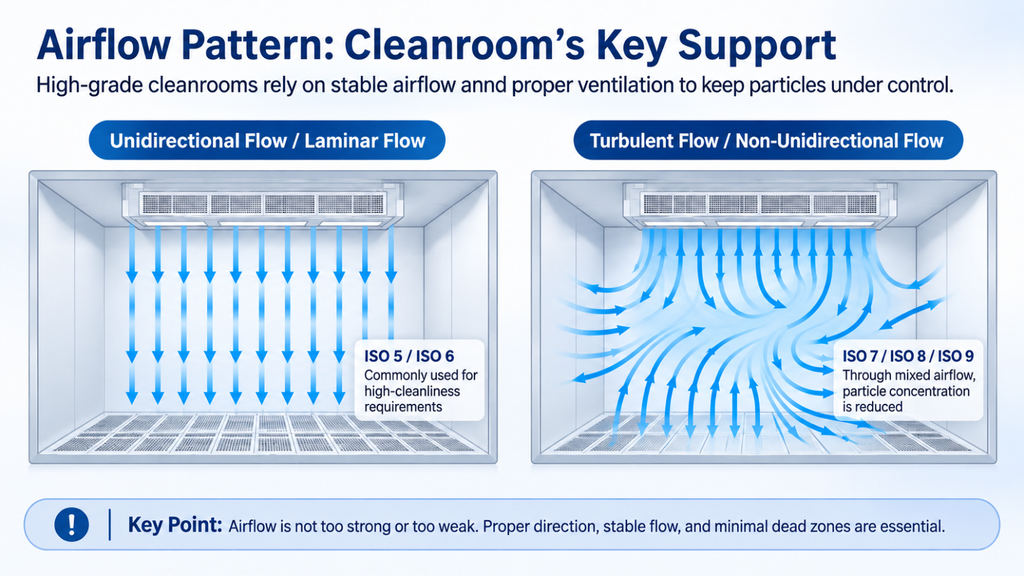
ISO 7 uses non-unidirectional flow (also called turbulent flow): the air that passed through HEPA filter enters the room from the top air supply outlets. It keeps diluting to reduce the particle concentration, and then is discharged from the low position return air outlets. The filtration efficiency of HEPA filter for 0.3 micron particles is above 99.97%. It is the decisive part in the whole system.
Pressure Cascades, Temperature, and Humidity
Pressure, temperature and humidity are also very important besides air. The adjacent lower level area should keep a positive pressure between 10 to 15 Pa inside the cleanroom. In this way, when the door opens, the air only flows outward, and keep the dirty air outside of the cleanroom. The temperature is generally controlled at 18-26℃, and relative humidity is between 45%-60%. This environment condition can not only keep the environment stable, but also restrain the growth of microorganisms.
ISO 7 vs. ISO 8 vs. ISO 5: Choosing the Right Class
Customers often ask that, which class should my product use? Is ISO 7 really enough? For detailed explanation, please see the table below:
|
ISO Class |
≥0.5 µm Particle Limit (particles/m³) |
Air Changes per Hour |
Typical Applications |
|---|---|---|---|
|
ISO 5 |
3,520 |
240–360 (unidirectional flow) |
Sterile filling, implantable medical devices |
|
ISO 7 |
352,000 |
30–60 |
Medical device assembly, pharmaceutical liquid preparation |
|
ISO 8 |
3,520,000 |
10–25 |
Injection molding, packaging, general cosmetics production |
It’s not the higher class the better. You should consider the requirements for cleanliness and safety of the specific product, and the construction and running cost of the cleanroom. The construction and running cost will rise a lot when the cleanroom class add one level. ISO 7 is usually the best choice for production, for most of our disposable sterile consumable products.
How ISO 7 Maps to EU GMP Grades B and C
Besides the American standard, you will also meet the EU GMP A/B/C/D classification, when your business is related to medicines and sterile medical devices.
The correspondence between the two is: ISO 7 is roughly equal to GMP Grade C at-rest state and Grade B in-operation state.
Gowning and Personnel Protocols in an ISO 7 Cleanroom
The biggest contamination source in the cleanroom is the people, not the equipment. Human hair, skin flakes and clothing fibers are producing particles all the time. So personnel management is the most important part in the daily running of ISO 7 cleanroom.
What to Wear: Garments and Materials
In order to make sure the cleanroom meets the standard, we have rules. If workers want to enter the ISO 7 cleanroom, they must wear:
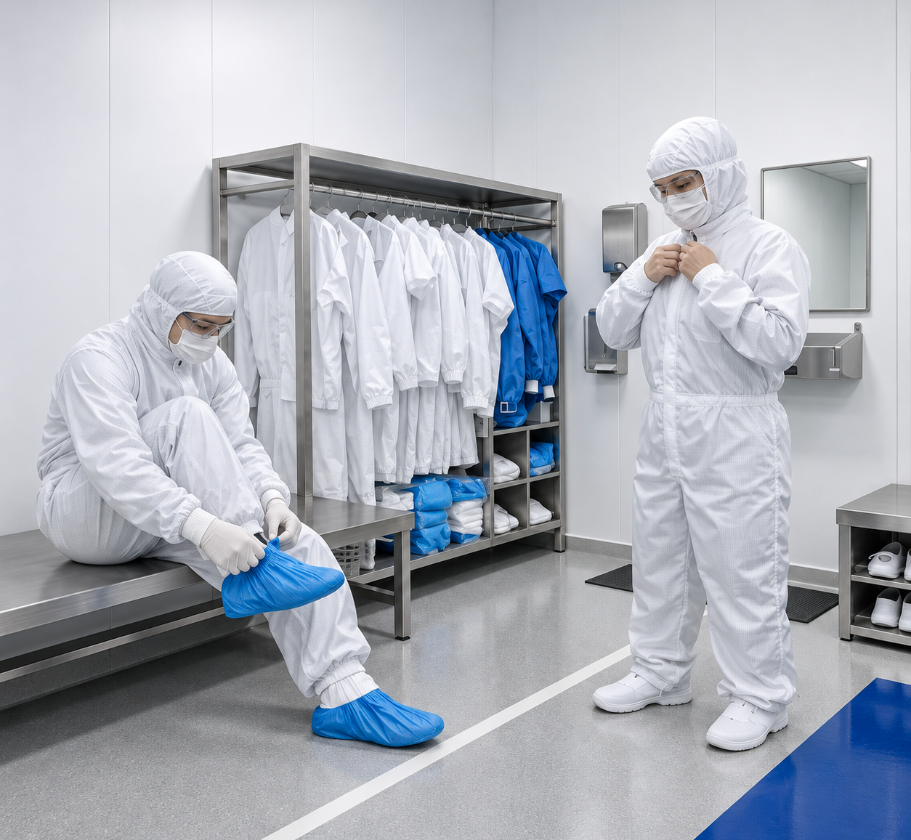
And the material of these garments also has rules. All garments must use special fabric that does not shed fibers. Some of them are disposable, and some are reusable clothes that will be sent to professional laundry company for treatment.
We give professional training to all workers who need to enter the cleanroom, and make sure every one of them is qualified. Untrained people are generally forbidden to enter the cleanroom. If there is exception, they will be accompanied by trained workers, and we make sure their entry procedure is same with the rules.
Gowning Room Layout and Entry Procedures
We set up an ISO 8 gowning room. Before workers enter the ISO 7 area, they must first enter this gowning room as a buffer. This operation may sound a little unnecessary and reduce efficiency, but in actual work you will finally find this gowning room is very necessary. Because once the cleanroom door opens to the outside for one minute, you maybe need to wait more than ten minutes for the cleanroom to recover to ISO 7. With this ISO 8 buffer gowning room, we can avoid spending too much time waiting for recovery during production. Although it is not completely avoided, the waiting time can be reduced from tens of minutes to a few minutes. So it is actually a practical way to improve the production line efficiency.
Besides the gowning room, we also set up an independent pass box. Materials can be passed in and out through this pass box, so as to avoid too many people going in and out and the cross contamination of air.
Keeping the Room Compliant: Monitoring and Recertification
A formal and responsible manufacturer, like R&G Bio, will not think that getting the cleanroom certification and submitting it to customers is the end and the effort is finished. Getting the certification is only the starting point. Keeping the cleanroom compliant is a process that need continuous effort every day and every moment. We put a lot of manpower in daily monitoring and maintenance. All these efforts are to let customers choose our products without any concern.
Routine Environmental Monitoring Under ISO 14644-2
The content of daily monitoring generally includes: floating particles, pressure difference, temperature and humidity. For products involving sterile, airborne bacteria and settling bacteria also need to be monitored. Of course, these monitoring contents are not made by us manufacturers casually. ISO 14644-2 has clear requirements on the monitoring frequency, points and methods. These records will be kept. Besides our internal management use, customers will also check them during factory audit and system audit. So you can feel free to place orders for R&G Bio products. We have confidence we will not let you down.
Requalification, HEPA Integrity Testing, and Documentation
Besides daily monitoring, the cleanroom also needs regular testing, usually once every 6 to 12 months. The testing content includes: particle counting, HEPA filter integrity leak test, air volume and air speed test, pressure recovery test and so on. Same as above, these testing results will also be kept on file, and will also be provided to customers for judgment.
Which Industries Rely on ISO Class 7 Cleanrooms?
Medical Device and Sterile Consumable Manufacturing
Medical device manufacturing is the field where ISO 7 is most widely used. Among these devices, the ones that most rely on ISO 7 cleanroom can be said to be the disposable sterile consumables that contact human body. Take our own products as example:
These processes are all finished in ISO 7 environment. These products will directly contact skin, mucosa and even blood vessels. One particle, even it is so tiny that the naked eye cannot see, will affect the user’s safety and the using effect. We must be responsible to customers.
Pharmaceuticals, Electronics, and Other Applications
Besides medical devices, the pharmaceutical industry and electronic manufacturing industry also often use ISO 7. As long as the production has high requirement on product cleanliness, but does not need to reach the sterile filling level, this class of cleanroom will be chosen.
5 Common Mistakes That Put ISO 7 Compliance at Risk
Based on R&G Bio’s current production history and accompanying information, we have selected the easiest and easiest way to proceed from the beginning.
Only test as-built, not test in-operation.
First, testing only in the as-built state while neglecting the operational state. Good as-built test results do not mean the cleanroom meets the required standards during production. Only monitoring results that meet the requirements in the operational state can ensure compliant production.
Pressure difference out of control
Door opened for long time, poor return air, these will all disturb the positive pressure and bring outside contamination.
Gowning not standard
Workers not covering hair, or not wrapping clean so part of hair is exposed; garment fibers shedding, not wearing standard garments; not going through the gowning buffer room. These will all make the cleanroom contaminated easily.
Materials brought in directly without treatment
The materials themselves also must be cleaned. Some workers with insufficient training will be lazy and bring materials in directly without treatment. The packaging of these materials contains dust, and will directly contaminate the cleanroom. So before bringing in, the material packaging should be removed first, or do a cleaning.
Monitoring records missing
We transfer full tecData must be kept on file. If you ask a manufacturer for monitoring data, and they make excuses saying the data is missing, then you have no way to know whether they actually did the monitoring or not. This kind of factory cannot be trusted.hnical documentation to your EU Authorized Representative and sign cooperation agreements.
Why Cleanroom Classification Matters When Choosing a Manufacturing Partner
Buyers definitely care most about product quality, and the cleanroom class is directly related to quality. So this is also one of the problems we pay most attention to in production.
R&G Bio’s production workshops are all built and run strictly according to ISO 7 standard. The whole production process has been done carefully, from assembly to inspection, then to packing. We put a lot of effort into every step. We have established normalized environmental monitoring and regular requalification mechanism. Our five product categories, Needle-Free Pens, 60IU & 80IU Pens, Syringes & Veterinary Supplies, PMU & Cosmetic Needles, Tattoo Needle Cartridges, are all produced in this high standard environment. If you are looking for a rigorous, responsible partner with real investment in clean production, you can visit our brand website:

R&G BIO
When you send inquiry, you can directly ask us for the third party testing report of cleanroom class, in-operation monitoring records and so on. We are very glad to provide these materials to you.